
Snake plants are famously hard to kill, but they do have one weakness that surprises owners: direct afternoon sun can scorch their leaves badly and permanently. If you moved your snake plant to a south-facing windowsill expecting it to “finally get the light it needs,” and the leaves suddenly have pale patches or crispy brown spots, you are looking at sunburn.
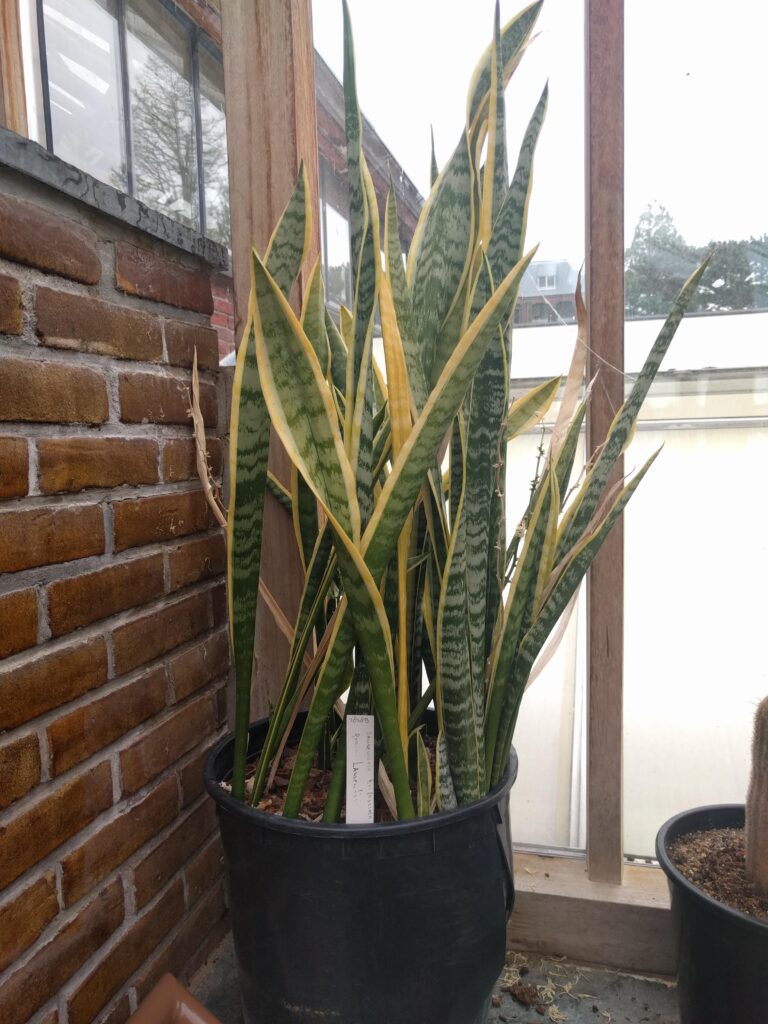
This guide explains exactly what sunburn looks like on snake plants, why it happens even to a “full sun” plant, how to fix an affected plant, and how to prevent it in the first place.
What Snake Plant Sunburn Actually Looks Like
Sunburn on snake plants has a distinctive pattern. Unlike watering issues (which affect the plant broadly) or pests (which leave visible signs like webbing or sticky residue), sunburn is purely a light-exposure problem and shows specifically where the sun hits.
Signs of mild sunburn
- Pale, washed-out patches on the outward-facing side of leaves (the side closest to the window)
- Yellowing or greenish-white discoloration that fades gradually into healthy green
- Variegation (the yellow stripes on Laurentii and other variegated cultivars) appearing bleached or ghost-like
- Slight leaf curl or folding on the sun-exposed side
Signs of moderate sunburn
- Brown, papery patches with dry texture
- Sharp boundaries between healthy green and damaged tissue
- Crispy edges along the leaf margins
- Sunken or slightly concave scorched areas compared to surrounding tissue
Signs of severe sunburn
- Deep brown or nearly black patches, usually in the center of the most exposed leaves
- Dry, brittle tissue that feels like paper
- The sun-facing side completely scorched while the back of the leaf (shaded side) remains green
- Affected leaves may later yellow entirely and drop from the plant
Why Snake Plants Can Sunburn (Despite Being “Full Sun Tolerant”)
Many plant guides list snake plants as tolerating full sun, which is true outdoors in their native West African habitat. Indoors, through window glass, the physics changes in two important ways:
Glass concentrates certain wavelengths
Window glass filters out most UV-B and some UV-A, but transmits most infrared (heat) radiation. An indoor snake plant in a south-facing window experiences more heat on its leaves than it would outdoors, because the glass acts like a greenhouse.
No wind cools the leaves
Outdoor plants lose heat through evaporation and breeze. Indoor plants sit in still air. Leaf surface temperature can climb 15 to 25°F above ambient room temperature when direct midday sun hits them.
Plants acclimate to their home lighting
A snake plant that has lived in medium indirect light for months develops thinner leaves with less protective pigmentation. Moving it abruptly to full sun exposes tissue that was not adapted to high-intensity light. The result is photo-oxidative damage: sunburn.
Will Sunburn Damage Heal?
The honest answer: no, not on the damaged tissue. Once a section of leaf is scorched, it stays scorched. Plant leaves do not regenerate the way skin does. The brown or pale sections remain visible on the leaf for its entire remaining life (which can be years).
What CAN happen:
- Mild pale patches sometimes darken back toward green if the plant is moved to more appropriate light and given time to rebuild pigmentation
- New leaves grown after moving to proper light will be fully healthy
- Severely damaged leaves eventually yellow and fall off, replaced by new growth from the rhizome over time
The plant as a whole almost always survives, even with significant leaf damage. The visible scars just stay.
How to Fix a Sunburned Snake Plant (Step by Step)
Step 1: Move the plant immediately
Do not leave it in the same spot “to see what happens.” Every additional day of direct sun causes more damage. Move the plant back at least 3 to 5 feet from the window, or to a spot with bright but indirect light (east-facing window, or deep into the room from a south-facing window).
Step 2: Do not cut off damaged leaves immediately
Even scorched leaves still photosynthesize in their healthy green portions. Cutting them off reduces the plant’s ability to recover. Leave them on for at least 2 to 3 months unless an entire leaf has yellowed or turned completely brown.
Step 3: Wait 4 to 6 weeks before major changes
Do not immediately fertilize, repot, or otherwise stress the plant. Let it stabilize in its new spot. Resume normal watering (every 2 to 3 weeks, checking soil first). Skip fertilizer for at least a month.
Step 4: Trim severely damaged leaves at the base
After 2 to 3 months, if specific leaves have mostly yellowed or turned brown, trim them at the base using a sterilized knife or pruning shears. Cut as close to the soil as possible without damaging the rhizome. This allows the plant to redirect resources to healthy tissue.
Step 5: Expect new growth in 3 to 6 months
A healthy snake plant recovering from sunburn will produce 1 to 3 new leaves within 3 to 6 months if conditions are right. These new leaves will be fully healthy. Over the next 1 to 2 years, the plant will largely replace the damaged older leaves through natural turnover.
How to Prevent Sunburn on Snake Plants
Understand your window exposures
South-facing windows (in the Northern Hemisphere) and west-facing windows get the most direct afternoon sun. East-facing windows get morning sun that is much gentler. North-facing windows rarely cause sunburn.
Generally safe placements:
- North-facing windows, any distance
- East-facing windows, any distance
- South or west-facing windows, at least 3 to 5 feet from the glass
- Filtered or shaded south/west windows (through sheer curtains)
Acclimate gradually if moving to brighter light
If you want to move a snake plant to a brighter spot, do it in stages over 2 to 3 weeks. Start with 1 to 2 hours of direct exposure daily, gradually increase. This gives the plant time to develop protective pigmentation.
Watch for early warning signs
Pale patches or variegation fading are the first signs. They appear within days to weeks of a light change. If you see them, move the plant before damage becomes permanent.
Use sheer curtains for south/west windows
A white or cream sheer curtain filters intense direct sun into gentle diffused light. Snake plants in a south-facing window behind a sheer curtain get ideal lighting without scorch risk.
Variegated cultivars are more vulnerable
Laurentii, Moonshine, and other variegated snake plant varieties sunburn more easily than solid-green types. The lighter tissue in variegation has less chlorophyll for photoprotection. Keep variegated types out of direct afternoon sun entirely.
What Sunburn Is Often Confused With
Root rot (overwatering)
Root rot causes yellowing that starts at the base and spreads upward, affecting leaves regardless of their position relative to windows. Sunburn specifically affects sun-facing surfaces. Root rot also causes mushy leaf bases; sunburn does not.
Pest damage
Mealybugs and spider mites leave visible signs: white cottony clusters (mealybugs) or fine webbing and tiny specks (spider mites). Sunburn has no visible organisms. If you see pests, address them; if not, consider light.
Underwatering / desiccation
Underwatered snake plants develop leaf wrinkling and folding, not dry scorched patches. Tissue becomes soft and rubbery, not papery. Watering usually restores them.
Fertilizer burn
Over-fertilization causes brown crispy leaf tips (not scorched patches mid-leaf) and often shows white salt crust on the soil surface. Flush the soil thoroughly to fix.
Cold damage
Cold or frost damage causes widespread leaf discoloration, often translucent or water-soaked appearance, that affects the whole plant. Sunburn is position-specific.
Can Sunburn Kill a Snake Plant?
Almost never. Even severely sunburned snake plants with half their leaves damaged typically survive and regrow over 6 to 18 months. Snake plants store energy in their rhizomes; losing visible leaves does not deplete the plant the way it would for most species.
The only scenario where sunburn contributes to plant death is when combined with other stresses: severe drought, root rot, pest infestation, or rhizome damage. A plant fighting multiple problems can decline past recovery. But sunburn alone is visual damage, not a life threat.
Frequently Asked Questions
Can I save a snake plant leaf that has one big brown patch?
The leaf itself will keep that patch permanently, but the leaf can still live on the plant and continue contributing (at reduced efficiency) for years. Do not cut it off unless the patch extends more than 50% of the leaf surface.
How long until new leaves replace sunburned ones?
3 to 12 months depending on light conditions after the move. A snake plant in bright indirect light (the ideal) produces 2 to 4 new leaves per year. After 18 to 24 months, most of the damaged leaves have been naturally replaced.
Why did my snake plant suddenly sunburn when it was fine all winter?
Seasonal sun angle changes. A plant that was safely 6 feet from a south window in winter (when the sun is low and shallow) can receive direct afternoon sun in summer when the angle shifts. Check window exposure every few months as seasons change.
Should I cover my snake plant with a sheer curtain year-round or just summer?
Year-round is safest for south- or west-facing windows. Winter sun at higher latitudes can still scorch if the plant is close to the glass. The filter does not hurt winter growth and prevents summer damage.
My snake plant is bleached all over, not just on one side. Is this sunburn?
All-over bleaching usually indicates the opposite: too little light, not too much. The plant is using up pigmentation reserves because it is not getting enough light to sustain them. Try more light, not less. See our snake plant care guide for lighting basics.
Can I use aloe vera gel on scorched plant leaves, like on a human?
No. Plant tissue does not heal the way animal tissue does. Applying aloe gel or similar remedies does nothing for sunburn damage. The only real treatment is better light placement and patience.
Will my sunburned snake plant grow more slowly permanently?
Temporarily yes. The damaged leaves cannot photosynthesize as efficiently as healthy ones. Expect growth to be 30 to 50% slower for the first 3 to 6 months after the sunburn event. Full normal growth rate returns once new healthy leaves dominate the canopy.
The Core Lesson
Snake plants are tough, but tough does not mean invincible. Direct afternoon sun through glass is one of the very few things that visibly damages them. The fix is simple: move the plant back from the window or add sheer curtain. The prevention is easier still: never put a variegated snake plant in a south or west window without a filter.
For other snake plant problems, see our guides on snake plant yellow leaves and how often to water snake plants. For indoor plant light in general, see the indoor plant light guide.