
If snake plants and ZZ plants survive by going completely silent and pothos communicates through subtle drooping, peace lilies talk in capital letters. They are the only common houseplant that wilts dramatically when thirsty, then perks back up within an hour of watering. There is no guesswork. There is no missing the signal. The peace lily is the houseplant for people who want a plant that actually tells them what it needs.
Add to that: peace lilies tolerate medium to low light, occasionally produce elegant white flowers indoors, and adapt to typical apartment conditions without complaining. They are not as drought-tolerant as snake plants, but they are far more communicative.
Why Peace Lilies Are Perfect for Black Thumbs
Most houseplants give you no warning before they fail. They look fine, then they look terrible, with no time to react. Peace lilies are the opposite. When a peace lily is thirsty, it droops so dramatically that you would have to be deliberately ignoring it to miss the signal. Watering brings it back to full upright posture within 60-90 minutes. This visible feedback loop is why peace lilies are recommended for first-time plant owners alongside pothos.
Beyond the watering signal, peace lilies are remarkably forgiving. They tolerate low light better than most flowering plants. They thrive in the higher humidity of bathrooms. They recover quickly from missed waterings. And unlike the silent killers (overwatering damage in snake plants takes weeks to show), peace lily problems become visible within days, giving you time to correct course.
In my experience, the only people who genuinely struggle with peace lilies are those who try to grow them in bone-dry, low-humidity conditions or in completely dark rooms.
Quick Care Summary
| Parameter | Requirement |
|---|---|
| Light | Medium-bright indirect, tolerates low |
| Water | Every 5 to 7 days, when leaves droop |
| Humidity | 40% to 60%, prefers higher |
| Temperature | 65°F to 80°F (18°C to 27°C) |
| Soil | Standard indoor potting mix with added perlite |
| Fertilizer | Balanced liquid, half-strength, every 6 weeks in spring/summer |
| Pet Safe | No — toxic to cats and dogs (calcium oxalates) |
| Difficulty | 2 / 10 (very easy) |
Peace Lily Basics: Know What You Are Growing
The peace lily is botanically Spathiphyllum, a genus of about 47 species native to the tropical Americas (primarily Colombia and Venezuela). The variety almost universally sold as houseplant is Spathiphyllum wallisii, with several cultivars varying in size from compact (10 inches) to giant (4 feet). Despite the common name, peace lilies are not true lilies (Lilium); they belong to the family Araceae, the aroid family that also includes pothos, philodendron, monstera, and ZZ plants.
In their native rainforest environment, peace lilies grow on the shaded forest floor under dense canopy, where filtered light and consistent humidity define their preferred conditions. Indoors, that translates to medium-bright indirect light and ambient humidity above 40%.
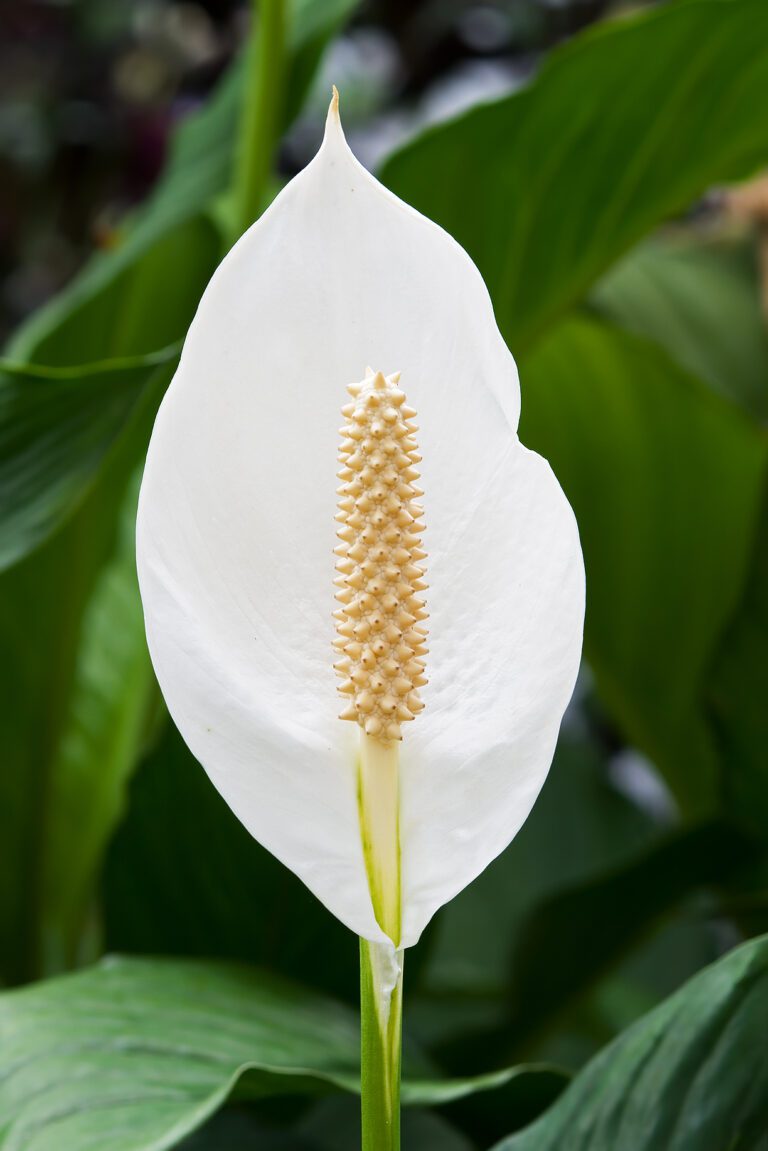
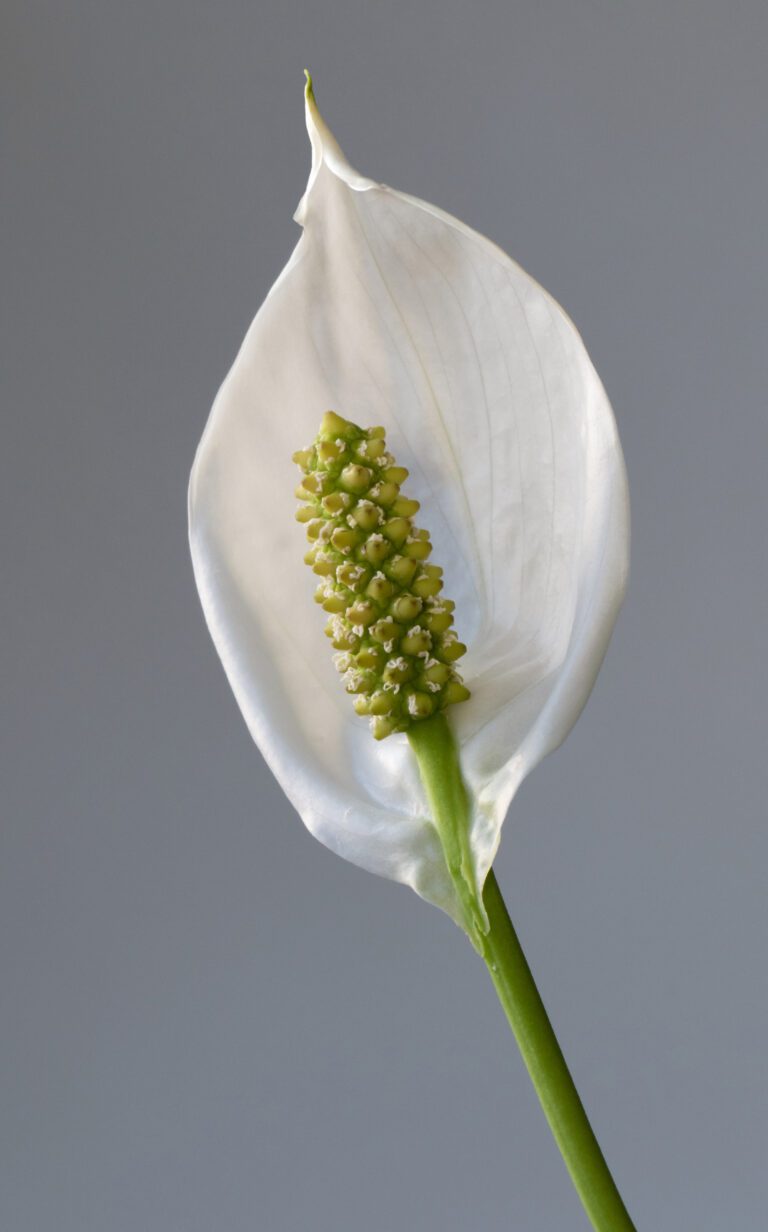
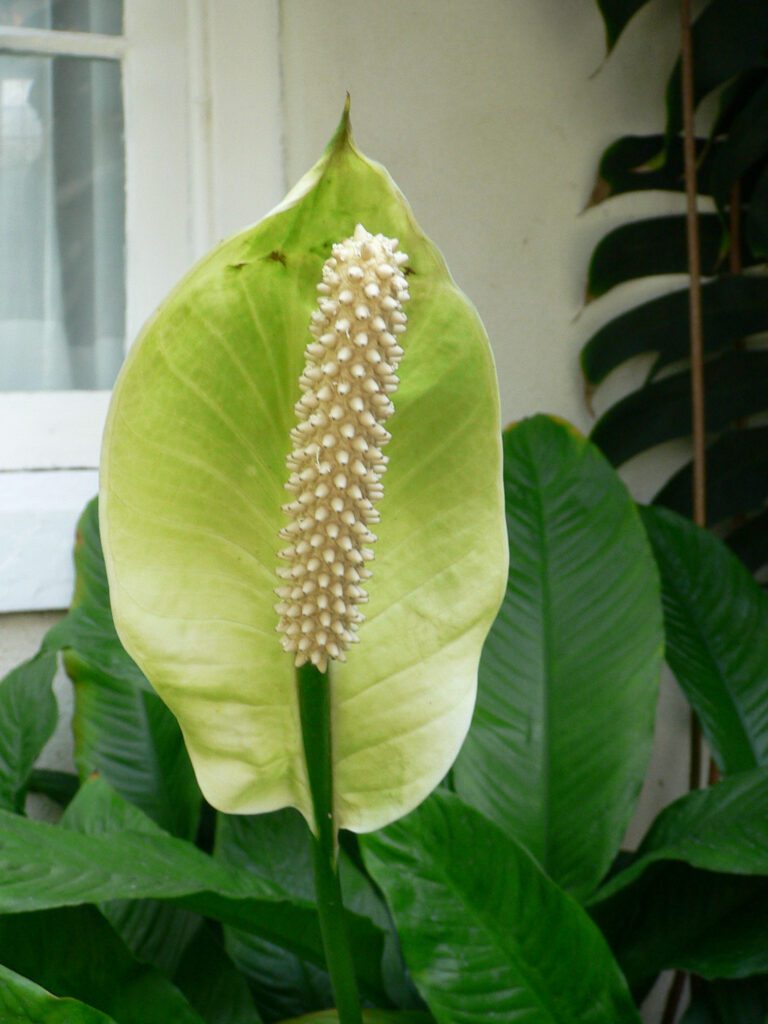
The famous white “flower” is actually a modified leaf called a spathe that surrounds the true flower (a small spike called a spadix). New spathes emerge bright white, age to green over weeks, and eventually wither. Plants typically flower in spring and summer, sometimes a second time in fall.
Common names you may see:
- Peace Lily (English-speaking world)
- Spath (collector shorthand)
- White Sails (descriptive)
- Mauna Loa (a specific cultivar, but often used generically)
Peace Lily Varieties Worth Knowing
Mauna Loa
The most common cultivar in stores. Medium-sized (1-2 feet tall), produces medium-sized white spathes. The default peace lily.
Sensation
The giant of the peace lily world. Grows 4-5 feet tall with leaves up to 2 feet long. Best as a floor plant in spacious rooms. Slower to flower but more dramatic than smaller varieties.
Domino
Variegated peace lily with white-streaked leaves. Slower growing than solid-green varieties but visually striking. Needs slightly brighter light to maintain variegation.
Picasso
Heavily variegated, with white-and-green splashed leaves. Patented and more expensive than Domino. Each leaf has unique markings.
Patricia
Compact variety (under 18 inches), prolific flowering. Good for smaller spaces or shelves where Sensation would be too large.
Peace Lily Origins and Why That Matters for Care
Knowing where peace lilies come from helps you understand why they want what they want. Spathiphyllum is native to the tropical rainforests of Colombia, Venezuela, and parts of Central America. In their wild habitat, peace lilies grow on the shaded forest floor under dense overhead canopy. The conditions they evolved in:
- Filtered light: sun mostly blocked by tree canopy, with dappled bright spots throughout the day. Never direct intense sun.
- High humidity: rainforest humidity stays above 70% year-round, far higher than typical homes.
- Consistent moisture: regular rainfall means the soil rarely dries out completely, but also drains quickly through the leaf litter substrate.
- Stable warmth: tropical temperatures stay in the 65-85°F range with little seasonal variation.
- Rich organic soil: decomposing leaf matter creates a constantly-renewing nutrient layer.
Translating these conditions to your home: peace lilies want medium-bright indirect light (mimicking dappled forest floor), humidity above 40% (lower than wild but tolerable), consistent watering before drooping appears (mimicking regular rainfall), warm and stable temperatures, and slightly moisture-retentive soil with good drainage.
The closer you get to these conditions, the better peace lilies perform. The further you stray (low humidity, dry-out cycles, cold drafts, direct sun), the more cosmetic problems appear despite the plant’s general resilience.
Light Requirements: Where to Put Your Peace Lily
Peace lilies are famous for low-light tolerance, but the reputation hides nuance. They survive in dim rooms but flower more reliably in medium-bright indirect light. If you want a peace lily that flowers regularly, give it more light than the bare minimum.
The ideal placement
3 to 6 feet from an east, west, or north-facing window. Medium-bright indirect light without direct sun. South-facing windows can work if filtered through sheer curtains.
What it will tolerate
- North-facing windows: Excellent. Peace lilies thrive here even when other plants struggle.
- Interior offices and bathrooms: Good if some natural or artificial light reaches the space.
- Direct sun: Bad. Leaves scorch within days. Always use sheer curtains or move back from south windows.
- Pitch-dark rooms: Survive but stop growing and never flower.
Signs of wrong light
Too much sun: yellow patches and crispy edges on outward-facing leaves. Too little light: no flowering, slow growth, occasional yellow leaves. Adjust accordingly. For a deeper light walkthrough, see our indoor plant light requirements guide.
Watering: The Easiest Plant to Get Right
Peace lilies are the only common houseplant that visibly wilts when thirsty. Leaves droop dramatically, almost flat. Within 30-60 minutes of watering, they perk back up to full upright posture. This visible feedback eliminates almost all watering guesswork.
The practical schedule: water when leaves start drooping or when the top inch of soil is dry. For most homes, this works out to every 5-7 days in summer and every 7-10 days in winter. The droop test is reliable enough that many peace lily owners never check soil at all.
How to water
Pour room-temperature water slowly across the soil surface until you see water draining from the bottom of the pot. Empty the saucer 15-30 minutes after watering. Do not water again until either the leaves droop or the top inch of soil feels dry.
Water quality matters more than for most plants
Peace lilies are sensitive to fluoride and chlorine in tap water. Heavy chlorine causes brown leaf tips over months. If your tap water is heavily treated, switch to filtered water (basic Brita pitcher works), let tap water sit out overnight (chlorine evaporates), or use rainwater. The Royal Horticultural Society’s houseplant watering guide covers water-quality nuances in more depth.
Overwatering is still possible
Despite the droop signal, peace lilies can be overwatered. Symptoms: yellow leaves at the base, mushy stems, sour smell. The fix is the same as for other plants: stop watering, let soil dry, trim rotten roots if needed.
For the full peace lily watering deep-dive, see our peace lily drooping guide.
Soil and Potting
Peace lilies prefer slightly moisture-retentive soil, the opposite of snake plants and ZZ plants. They do best in standard indoor potting mix with extra perlite for drainage.
The right mix
- 3 parts standard indoor potting soil
- 1 part perlite
- Optional: a handful of orchid bark for extra airflow
Pot material
Plastic, ceramic, or glazed pottery all work. Terracotta dries soil faster than peace lilies prefer; if you use terracotta, plan to water more often. Drainage holes are mandatory.
Pot size
Peace lilies like being slightly root-bound (it actually encourages flowering). Repot every 2-3 years, going only 1-2 inches wider. A pot too large stays wet too long and risks root rot.
Fertilizing Your Peace Lily
Peace lilies need modest amounts of fertilizer to flower well. Not too much (which causes leaf burn and reduces flowering), not too little (which causes pale leaves and no flowers).
What to use
A balanced liquid houseplant fertilizer (10-10-10 NPK) diluted to half strength. Or a fertilizer formulated for flowering houseplants if you want more reliable blooming.
How often
Every 6 weeks during spring and summer. Skip fall and winter entirely. Peace lilies that have not been fertilized in over a year may produce few flowers; resume fertilizing in spring.
Signs of over-fertilizing
Brown crispy leaf tips, white salt buildup on soil surface, sudden leaf yellowing. Flush soil with plain water and skip fertilizer for 2-3 months.
Repotting Your Peace Lily
Peace lilies prefer being slightly root-bound, so repotting is needed less often than for fast-growing plants like pothos. Most peace lilies need repotting every 2-3 years, sometimes longer.
When to repot
- Roots growing out of drainage holes
- Plant drying out within 2-3 days of watering (root mass crowding out soil)
- Soil pulling away from pot edges and not absorbing water properly
- Plant has tripled in size since last repotting
- Mineral salt buildup visible on soil surface despite flushing
How to repot
Best done in spring as growth resumes. Choose a pot 1-2 inches wider than the current one (not larger; oversized pots cause root rot). Use fresh well-draining potting mix. Slide the plant out carefully, gently loosen the outer root mass with your fingers, and plant at the same depth as before. Water lightly to settle the soil. Wait 5-7 days before normal watering to let any disturbed roots heal.
What to avoid
Do not repot a stressed or actively flowering plant. Wait until flowers fade and the plant looks generally healthy. Do not jump multiple pot sizes at once; this leads to root rot from excess unused soil. Do not use moisture-retaining African violet mixes; peace lilies need better drainage.
How to Encourage Peace Lily Flowering
Most peace lily owners want their plant to flower more often. The white spathes are striking, and a flowering peace lily transforms an otherwise unassuming plant into a centerpiece. Six factors influence flowering reliability:
Light is the biggest factor
Peace lilies in low light may live for years without ever flowering. The same plants moved to medium-bright indirect light often produce spathes within 3-6 months. If your peace lily has not flowered in over a year, brighter light is the most likely fix.
Plant maturity
Young peace lilies (under 1-2 years old) often do not flower. The plant invests its energy in leaf production first. Once established, flowering becomes regular. Be patient with newly purchased smaller plants.
Slightly root-bound conditions
Counterintuitively, peace lilies in slightly snug pots flower more reliably than ones in oversized pots. The mild root constraint signals the plant to reproduce. If you repot, go only 1-2 inches wider, not larger.
Phosphorus-balanced fertilizer
Standard balanced fertilizer (10-10-10) works for general care, but if you specifically want more flowers, switch to a phosphorus-emphasized fertilizer (something like 15-30-15) during spring and summer. Phosphorus encourages bloom production.
Stable temperatures
Peace lilies flower best when temperatures stay consistently in the 65-80°F range. Sudden cold snaps or temperature swings disrupt flower bud formation.
Patience between blooms
Healthy peace lilies bloom 1-2 times per year, typically in spring and again in late summer. Each spathe lasts 4-6 weeks before fading. Trim spent spathes at the base of their stem to redirect energy to new growth.
How to Propagate Peace Lilies
Unlike pothos (super easy stem cuttings) or snake plants (multiple methods), peace lilies propagate primarily by division. Stem cuttings do not work because peace lilies grow as a clumping rosette without true stems.
Division (the only reliable method)
When repotting a mature peace lily, gently slide it out of the pot and look for natural divisions in the root mass. Each division should have at least 2-3 leaves and a healthy section of roots. Separate divisions by gently pulling apart or cutting through with a sterilized knife. Pot each division in fresh, well-draining soil. Water lightly after 2-3 days. New divisions establish in 4-6 weeks.
Mature peace lilies typically yield 2-4 divisions when separated. The mother plant continues growing in its original pot.
For full propagation step-by-step including timing and after-care, see the broader indoor plant propagation guide (when published).
Peace Lily Pests: What to Watch For
Peace lilies are not pest-magnets, but they are not immune. Three pests show up most often, and early identification makes treatment far easier than letting infestations spread.
Mealybugs
White, cottony clumps in leaf joints (where leaves meet the stem) and undersides of leaves. They suck plant juices and excrete sticky honeydew that can lead to sooty mold. Treatment: wipe each visible cluster with a cotton swab dipped in 70% isopropyl alcohol. Repeat every 4-7 days for 3 weeks until no new clusters appear. For heavy infestations, follow alcohol wipes with insecticidal soap spray on all leaf surfaces.
Spider mites
Tiny tan or red specks (less than 1mm) on the undersides of leaves, with fine webbing between leaves and stems. More likely in dry winter air. Treatment: shower the plant thoroughly with room-temperature water to dislodge mites. Apply insecticidal soap or neem oil to all leaf surfaces (top and bottom). Repeat weekly for 3 weeks. Increase ambient humidity to discourage future infestations.
Scale insects
Brown or tan armored bumps on stems and leaves, easily mistaken for part of the plant. They cause yellowing and weakening over time. Treatment: scrape off bumps with a thumbnail or cotton swab dipped in alcohol. Follow with insecticidal soap weekly for 3-4 weeks. Severely infested leaves may need to be removed entirely.
Prevention
Inspect leaves monthly, especially undersides and where leaves meet stems. Quarantine any new plants for 2-3 weeks before placing near established collections. Maintain humidity above 40% to discourage spider mites. Wipe leaves periodically with a damp cloth to remove dust and check for early pest signs.
Common Peace Lily Problems
Drooping leaves
Almost always thirst. Water immediately and the plant recovers within 1-2 hours. Persistent drooping after watering indicates root rot. See our peace lily drooping guide.
Brown leaf tips
Tap water chemistry (fluoride, chlorine), low humidity, or fertilizer salt buildup. See our peace lily brown tips guide.
Yellow leaves
Overwatering, low light, or natural aging. See our general yellow leaves guide for the systematic diagnosis.
Not flowering
Too little light is the most common cause. Move to a brighter spot. Other causes: under-fertilizing, too-large pot, very young plant.
Pests
Peace lilies occasionally attract mealybugs, spider mites, and scale. Treatment: wipe affected areas with cotton dipped in 70% isopropyl alcohol, repeat weekly for 3 weeks. Heavy infestations respond to insecticidal soap.
Is Peace Lily Toxic to Pets?
Yes. Peace lilies are toxic to cats and dogs, listed by the ASPCA. The toxic compounds are insoluble calcium oxalate crystals, present throughout the plant.
What happens if a pet chews on peace lily
The crystals cause immediate oral irritation, drooling, vomiting, and in some cases throat swelling. The reaction is painful but rarely life-threatening. Most pets stop chewing quickly because of the burning sensation.
Important note about lilies and cats
Peace lilies are NOT true lilies (the deadly genus Lilium). True lilies (Easter, Asiatic, Tiger, Day) are extremely dangerous to cats and can cause kidney failure. Peace lilies are mildly toxic in comparison. Still, keep peace lilies out of reach if your cat is a known plant-chewer.
What to do if it happens
Rinse your pet’s mouth with water. Call your vet or the ASPCA Animal Poison Control Center at 888-426-4435. Watch for throat swelling or breathing difficulty.
Safer alternatives
Pet-safe houseplants with similar appearance: spider plant, cast iron plant, parlor palm. See our complete pet-safe houseplants guide.
Styling and Placement Ideas
Bathrooms
Peace lilies thrive on bathroom humidity. The steam from showers, combined with medium light, creates near-ideal conditions. A peace lily on a bathroom shelf or in a corner is a classic setup.
Bedrooms
Tolerates the medium light in most bedrooms. Peace lilies were included in NASA’s air-cleaning studies and are popular for bedrooms (though the air-purification effect at typical home plant densities is minimal).
Offices
Handles fluorescent office lighting well. The dramatic drooping tells coworkers when the plant is thirsty, eliminating the need for office-wide watering schedules.
Low-light corners
Among the only flowering plants that survive in low light. A peace lily in a dim corner outperforms most attempts at flowering plants in similar conditions.
What to avoid
Direct sun (scorches leaves), drafty windows in winter (cold damage), and pots without drainage (root rot). Also avoid placing on the floor in pet households where curious cats or dogs can reach.
Year-Round Peace Lily Care Calendar
Spring (March to May)
Growth resumes. Water when leaves droop or top inch is dry, roughly every 5-7 days. Resume fertilizing every 6 weeks at half strength. Best season for flowering. Best time to repot or divide.
Summer (June to August)
Peak growth and flowering. Water every 4-6 days as needed. Continue fertilizing every 6 weeks. Wipe leaves monthly to remove dust. Watch for pests in dry summer air.
Fall (September to November)
Growth slows. Stretch watering to every 7-10 days. Stop fertilizing in late September. Move plants away from cold windows.
Winter (December to February)
Slowest growth. Water every 8-12 days as needed. Do not fertilize. Keep temperatures above 55°F. Brown leaf tips often appear in dry winter air; a humidifier helps.
Peace Lily Lifecycle: What to Expect Year by Year
Understanding what a peace lily does over its lifetime helps you set realistic expectations and recognize normal versus abnormal changes.
Year 1: establishment
A new peace lily (whether store-bought or freshly divided) spends its first year establishing roots and producing leaves. Flowering may not occur. Growth is slow but steady. The plant adapts to your home’s specific light, humidity, and water rhythm.
Years 2-3: maturity and regular flowering
Established peace lilies typically begin flowering reliably in year 2-3. Expect 1-2 spathes per year in good conditions. Plant size increases noticeably; you may need to repot once during this period as roots fill the original pot.
Years 4-5: peak performance
Peace lilies in their fourth or fifth year often produce the most flowers and largest leaves of their lifetime. This is when the plant looks most impressive. Repotting may be needed at year 4-5 as the root mass becomes dense.
Years 6-8: division opportunity
By year 6-8, the plant has typically grown into a dense clump with multiple distinct rosettes. This is the ideal time for division — separating the plant into 2-4 new plants restarts the cycle and prevents the original plant from becoming overcrowded.
Years 9+: continued vigor with division
Peace lilies divided every 5-8 years can effectively live indefinitely. Each division extends the genetic line. Without division, mature plants slowly decline as the central rosette becomes overcrowded and leaf quality drops.
Common Peace Lily Cultivars Compared
| Cultivar | Mature Height | Flower Size | Best For |
|---|---|---|---|
| Mauna Loa | 1-2 ft | Medium (4-6 inches) | Default choice, widely available |
| Sensation | 4-5 ft | Large (8-10 inches) | Floor plant, statement piece |
| Domino | 1-2 ft | Medium | Variegated foliage interest |
| Picasso | 1-2 ft | Medium | Heavy variegation, collector piece |
| Patricia | under 18 in | Small (3-4 inches) | Small spaces, prolific blooming |
| Wallisii (Original) | 1-2 ft | Small | Compact, more bloomy than Mauna Loa |
| Power Petite | under 12 in | Small | Desks and shelves |
Where to Buy a Healthy Peace Lily
Good sources
- Big-box stores (Home Depot, Lowe’s): widely available, $15-$30 for 6-inch pots. Inspect carefully for over-watered specimens.
- Local nurseries: often better quality, with knowledgeable staff for cultivar selection.
- Online specialists (The Sill, Bloomscape): higher prices, well-packaged plants, broader cultivar selection.
What to look for
- Firm, glossy dark green leaves
- No yellow leaves at the base
- Soil slightly damp but not soggy
- At least one or two new leaves emerging from the center
- Bonus: an existing or developing white spathe
Warning signs
- Drooping leaves on damp soil (root rot)
- Yellow leaves at the base (overwatered in-store)
- Brown crispy leaf tips throughout (water quality damage)
- Sticky residue on leaves (mealybug or scale honeydew)
Frequently Asked Questions
How long do peace lilies live?
With decent care, 5 to 10 years is typical. Mature peace lilies in good conditions can live longer, especially when divided periodically. Each division extends the genetic lineage indefinitely.
Why won’t my peace lily flower?
The most common cause is insufficient light. Move to a brighter (indirect) location and expect flowering within 3-6 months. Other causes: under-fertilizing, too-young plant (peace lilies often don’t flower until 1-2 years old), or too-large pot.
How often does a peace lily flower?
Established healthy peace lilies typically flower 1-2 times per year, usually in spring and again in late summer or fall. Each spathe lasts 4-6 weeks before fading.
Can I cut off old brown peace lily flowers?
Yes. Trim spent spathes at the base of the flower stem with sterilized scissors. This redirects energy to new growth and improves the plant’s appearance.
Are peace lilies easy enough for beginners?
Yes. Peace lilies are among the most communicative houseplants (drooping signals thirst clearly), tolerate medium-low light, and recover quickly from setbacks. They are an excellent first or second houseplant.
Do peace lilies actually purify air?
Slightly. Peace lilies were included in NASA’s 1989 Clean Air Study and shown to remove some indoor pollutants. The effect at normal household plant density is minimal. Buy peace lilies for their appearance and ease, not as air-quality solutions.
Final Thoughts
Peace lilies are one of the easiest flowering houseplants to keep alive, and the dramatic droop signal makes them especially good for beginners learning to read plant communication. They thrive in conditions that defeat most flowering plants (medium-low light, average humidity, irregular watering).
For watering specifically, see the peace lily drooping guide. For brown tip troubleshooting, the brown tips guide covers the most common cosmetic complaint. For more in this category of beginner-friendly plants, our complete guide to hard-to-kill houseplants has the broader list, and our beginner’s guide provides an introductory framework.
The plant tells you what it needs. Peace lilies just say it louder than most.