
Windowless bathrooms are one of the most common “impossible” plant situations people describe. High humidity, no natural light, artificial lighting that switches on and off unpredictably — most houseplants hate at least two of those three conditions. Unsurprisingly, the vast majority of Instagram-famous plants die quickly in this environment.
But a specific group of tropical understory plants actually benefit from the humidity and tolerate the darkness. If you want greenery in your windowless bathroom, stop browsing pothos variants and start here.
Why Windowless Bathrooms Are Tricky (and What Works in Your Favor)
Three bathroom features define what survives and what dies:
- No natural light: The limiting factor. Only shade-tolerant species work.
- High humidity during showers: 60 to 90% humidity spikes, then back down to normal. Most low-light plants love this.
- Temperature swings: Hot showers warm the room temporarily. Most tropical plants tolerate this fine.
The humidity is actually a superpower. Many low-light plants also prefer higher humidity than standard indoor air provides. A windowless bathroom is one of very few rooms that offers both at once.
The 9 Best Plants for Windowless Bathrooms
Ranked by combination of darkness tolerance and humidity preference.
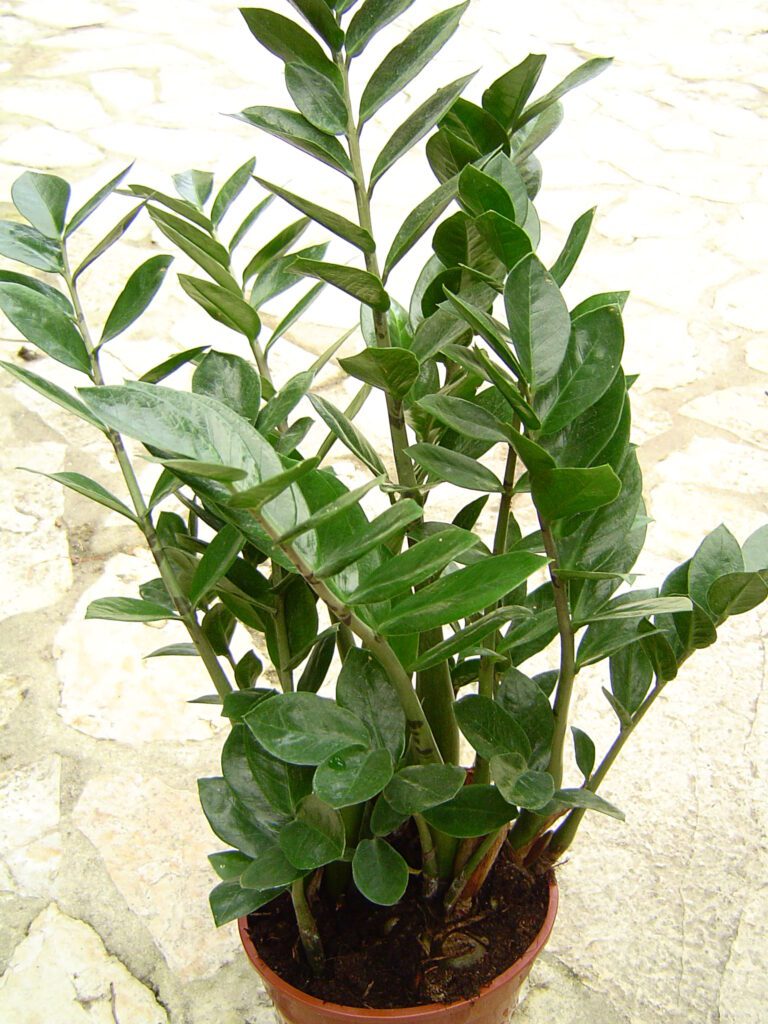
1. ZZ Plant (Zamioculcas zamiifolia)
The default answer for any dim room, including bathrooms. ZZ plants tolerate no direct light for months and do not mind humidity swings. Growth stops in true darkness, but the plant remains firm and upright. Water every 3 to 4 weeks; less if the bathroom stays permanently humid.
Light: any, including overhead bathroom fixture only. Watering: very infrequent. Size: 2 to 3 feet. Pet safe: no. See our ZZ plant guide.
2. Pothos ‘Jade’ (Epipremnum aureum)
The solid-green Jade variety handles bathroom conditions better than variegated pothos. Drape it over the top of a cabinet or let it trail from a hanging planter. Appreciates the humidity but tolerates drying out. Avoid Marble Queen or N’Joy; they lose their variegation in low light.
Light: low, ambient LED only. Watering: every 10 to 14 days. Size: trailing 4 to 10 feet. Pet safe: no. See our pothos guide.
3. Peace Lily (Spathiphyllum)
Thrives in bathrooms. The humidity keeps its leaves from browning at tips (a common issue in dry rooms), and it flowers occasionally even in windowless conditions. Droops dramatically when thirsty, so watering cues are obvious. One of very few plants that flowers in windowless spaces.
Light: low to ambient. Watering: every 5 to 7 days. Size: 1 to 2 feet. Pet safe: no, toxic. See our peace lily guide.
4. Boston Fern (Nephrolepis exaltata)
Classic bathroom plant. Loves humidity (requires it, really). Tolerates lower light than most ferns, especially in consistently humid spaces. The high humidity of a bathroom offsets the low-light stress. Expect some leaf browning at the outer edges; trim off and keep going.
Light: low to medium, requires humidity. Watering: keep consistently moist. Size: 1 to 3 feet. Pet safe: yes.
5. Snake Plant (Dracaena trifasciata)
Surprisingly happy in bathrooms despite preferring dry air elsewhere. The upright structure resists rot even in humid conditions because water beads and rolls off the waxy leaves. Avoid splashing water directly into the central rosette. Water every 3 to 4 weeks in bathroom conditions.
Light: any. Watering: infrequent. Size: 2 to 4 feet. Pet safe: no, mildly toxic. See our snake plant guide.
6. Chinese Evergreen (Aglaonema)
Evolved specifically for rainforest floor conditions. Loves the humidity, accepts the darkness, looks more “lush” than the architectural low-light options above. Solid-green varieties (Silver Bay, Red Siam) tolerate the least light; darker cultivars need a bit more ambient brightness.
Light: low to medium. Watering: every 7 to 10 days. Size: 1 to 3 feet. Pet safe: no, toxic.
7. Heartleaf Philodendron (Philodendron hederaceum)
A hardy trailing vine more shade-tolerant than pothos. Good for bathroom shelves or hanging from curtain rods. Handles humidity well. Grows slowly in windowless rooms but stays healthy for years.
Light: low to medium. Watering: every 7 to 10 days. Size: vines 3 to 8 feet. Pet safe: no, toxic.
8. Lucky Bamboo (Dracaena sanderiana)
Often sold in water-only setups, which suits a humid bathroom. Tolerates very low light indefinitely. Grows slowly. Change the water every 2 weeks to prevent algae and bacterial buildup. Do not actually a bamboo; it is a dracaena species.
Light: low. Watering: in water, change every 2 weeks. Size: 1 to 3 feet. Pet safe: no, toxic.
9. Spider Plant (Solid Green Variety)
The solid-green variety of spider plant (Chlorophytum comosum ‘Green’) tolerates lower light and higher humidity than its variegated cousin. Will produce baby plantlets you can propagate. Looks good in a hanging basket from a shower rod.
Light: low to medium. Watering: every 7 to 10 days. Size: 1 to 2 feet plus plantlets. Pet safe: yes.
Plants to Avoid in Windowless Bathrooms
Common recommendations that fail for specific reasons:
Succulents and cacti
Too little light and too much humidity. Succulents rot within weeks in bathroom conditions. Do not make this mistake just because the plant is small and cute.
Orchids (most species)
While orchids love the humidity, they need significantly more light than a windowless bathroom provides. Would need a dedicated grow light to survive.
Fiddle leaf fig
Already notoriously fussy. Requires 6+ hours of bright indirect light daily. A windowless bathroom is a death sentence.
Variegated varieties
Marble Queen pothos, variegated Chinese evergreen, and similar plants lose their variegation in low light. Stick to solid-green varieties.
Plants that need dry air
Some Mediterranean herbs (rosemary, thyme) and desert plants (agave, haworthia) hate the humidity. Keep them elsewhere.
Placement and Care Tips for Bathroom Plants
Put plants near the light, not in corners
Even in a windowless bathroom, the center of the ceiling near LED fixtures is brighter than shadowed corners. Hang or shelf plants close to the actual light source.
Use light-colored walls as reflectors
White or cream walls amplify what light there is. Dark-painted bathrooms are hostile even to the most tolerant plants.
Water less than you think
Plants in humid rooms use water slower than the same plants in dry rooms. A snake plant that wants water every 14 days in a dry office might go 21 to 28 days in a humid bathroom. Always check the soil before watering.
Rotate plants out every few months
Even the most tolerant bathroom plants benefit from occasional breaks in a brighter room. Swap them quarterly with plants from a room with more light. See our windowless apartment guide for rotation strategy.
Keep plants away from shower spray
Wet leaves invite fungal issues even in humidity-loving plants. Position plants on shelves or hanging spots where shower water cannot directly splash them.
Wipe leaves monthly
Soap scum and mineral buildup from shower steam coat leaves over time. A damp cloth once a month keeps photosynthesis efficient.
If You Want to Grow More Than These 9 Plants
A small LED grow light transforms a windowless bathroom into a plant paradise. A single 20 to 40 watt full-spectrum bar light mounted under a cabinet or on a shelf supports almost any low-light plant, and higher-light plants if positioned close. See our indoor plant lighting guide for grow light specifics.
How to Increase Light in a Windowless Bathroom
The single best thing you can do for bathroom plants is add more functional light, even if you cannot add a window. Three approaches work, in order of impact.
Add a full-spectrum LED fixture near the plants
A $25 to $40 LED grow strip mounted above a shelf or under a cabinet delivers 10 to 30 times more plant-usable light than an overhead ceiling fixture. You plug it into a timer and forget about it. The light is white (not the purple grow-light look), so it integrates into normal bathroom aesthetics. This single upgrade lets you grow dozens of plants a windowless bathroom otherwise could not support.
Mount it 12 to 24 inches above the plant. Run it on a timer for 12 to 14 hours daily. Most bathroom grow-light setups cost less than $50 total and last years.
Use mirrors to amplify existing light
A large mirror opposite your main bathroom light fixture roughly doubles the usable light at plant level. This is an old trick from Victorian-era plant owners who grew ferns in gas-lit hallways. A single strategically placed mirror can turn an “impossible” bathroom corner into a viable plant spot.
Place plants where they can receive both direct overhead light and reflected light bouncing off the mirror. The plant gets the same total illumination as a room with nearly twice the ceiling lights.
Switch to brighter, cooler-toned bulbs
Standard bathroom bulbs are often 2700K warm-white, which looks flattering on skin but provides less usable plant light than 4000K or 5000K daylight-white bulbs. Switching bulbs is a 5-minute, $15 upgrade. Your skin might look slightly clinical under 5000K, but plants photosynthesize significantly better. A good middle ground: use 4000K “soft daylight” bulbs, which look fine to humans and help plants.
Lumens matter more than watts. Aim for at least 800 lumens total from your bathroom fixtures, ideally 1500+ if you want more than the 9 plants from the list above.
Paint or tile for reflectivity
White or light-cream walls and ceilings bounce roughly 90% of light back into the room. Dark walls (navy, charcoal, forest green) absorb 60 to 80% of light and make any room plant-hostile. If your bathroom is currently painted dark and you want plants, painting white or cream ceiling + upper walls increases plant-usable light dramatically. Tile does the same; a tiled bathroom in off-white or pale gray is naturally brighter than one in dark stone.
You do not need to redo your whole bathroom. Even painting just the ceiling white (if it is currently darker) makes a measurable difference.
Leave the light on longer
Free solution: most bathroom plants struggle because the overhead light only runs for 5-minute bursts during showers. Leave the light on for 2 to 4 hours in the evening when you are home. Plants need total hours of exposure, not high-intensity bursts. Four hours of normal bathroom light daily beats 30 minutes of bright light.
Can Plants Really Survive With Zero Natural Light?
Technically, plants need light to photosynthesize. “Zero light” would kill any plant. But what most people mean by “no natural light” in a bathroom is actually “no direct sunlight, plus some artificial light when I turn on the bathroom fixture.” That is enough for a specific subset of plants.
What the champions tolerate
A mature ZZ plant stores so much energy in its rhizomes that it survives for months in genuinely dark storage conditions. It does not grow, but it stays alive. Bring it back to any ambient light (including a basic bathroom fixture on for a few hours daily) and it resumes slow growth.
Snake plants, cast iron plants, and pothos Jade behave similarly. They enter a low-metabolism survival state in extended darkness and recover when light returns.
What “just bathroom light” can support
Standard bathroom LED fixtures (typical new installation: 400 to 800 lumens at plant level) running for 8+ hours daily supports most plants on our top-9 list. Under 4 hours daily of exposure, only the top 3 (ZZ, cast iron, snake plant) truly thrive.
The trick most people miss: leave the bathroom light on for a few hours daily even when you are not in the room. Your electric bill goes up by pennies, and your plants gain meaningful photosynthesis time.
The absolute minimum threshold
Below about 50 lux (foot-candles) of average daily light, no plant survives long-term. This is darker than even a windowless bathroom with occasional light use. If you are in this situation, a $25 LED grow strip transforms the possibility space. Without supplemental light, even ZZ plants eventually decline.
What fails to survive
Most houseplants need at least bright indirect natural light plus some direct exposure. Even with LEDs, the following fail in windowless bathrooms:
- All succulents and cacti (need direct bright light)
- Fiddle leaf figs (require 6+ hours of direct bright)
- Most flowering plants (blooms need bright light)
- Calatheas (the humidity helps but light is still insufficient)
- Citrus and other fruiting plants (need several hours of direct sun daily)
Bathroom Plant Styling: Where to Actually Put Them
Windowless bathrooms are often small, which means plant placement matters more. Here are spots that work consistently without interfering with bathroom function.
Above the toilet tank
Usually dead space, often has at least some ambient light, above the splash zone. A small trailing pothos or philodendron mounted on a floating shelf softens the sterile look of a toilet area. Add a $15 floating shelf, a 4-inch pot, and you have a styling piece that would otherwise be empty wall.
On a shelf above the shower door or curtain rod
Humidity rises and hangs above the shower area. A low-light-tolerant plant on a floating shelf here gets free humidity exposure. Good for Boston ferns, pothos, and peace lilies.
Corner floor plants for larger bathrooms
If the bathroom has 40+ square feet, a tall floor plant (snake plant, ZZ plant, dracaena) in an otherwise unused corner anchors the space. Use a self-watering floor planter if the corner is far from a water source.
Counter corners and vanity tops
Small plants (4-inch ZZ, 6-inch pothos Jade, mini snake plant) occupy unused counter space without crowding toiletries. Great for first-time bathroom plant owners because they are within eye level for watering reminders.
Hanging from the ceiling
Ceiling hooks with macramé hangers suspend trailing plants (pothos, philodendron, spider plant) in a way that uses vertical space without taking floor or counter room. Mount hooks into ceiling joists, not drywall. Good for narrow bathrooms.
Placement mistakes to avoid
Do not put plants directly in the shower spray zone (constant wet leaves invite fungus). Do not put plants on top of toilet lids (unstable, gets splashed). Do not group plants against outside walls in cold climates (they get cold drafts through tile). Do not put plants on radiators or near heat registers (dries them out quickly).
Frequently Asked Questions
Can I keep a plant in a bathroom with only a shower light fixture?
Yes, for the most tolerant species (ZZ plants, cast iron plants, snake plants). Just ensure the light is on for at least a few hours daily. If you shower and then leave immediately, the plant is getting very little total light time. Consider leaving the bathroom light on for an hour in the evening while you are home.
Do bathroom plants prevent mold and humidity problems?
Marginally. A few small plants do not meaningfully reduce bathroom humidity. The ventilation fan does far more than plants ever will. Do not buy plants as an anti-mold strategy; buy them because you want plants. Install a proper exhaust fan for humidity control.
Will shampoo, soap, or steam harm my plants?
Occasional splashes of soap or shampoo onto leaves cause mild stress but are not fatal. Frequent heavy exposure (plant directly in the shower stream) will damage leaves. Steam itself is harmless; it is just hot water vapor, which plants enjoy.
Can I leave my bathroom plants when I travel for a week or more?
Most of the plants on this list survive 2 to 4 weeks without attention. ZZ plants, snake plants, and cast iron plants can survive even longer. Boston ferns and peace lilies are the exception — they need watering every few days and will struggle with a week of neglect.
What is the best plant for a dark guest bathroom used only occasionally?
ZZ plant, hands down. It survives months of neglect, tolerates complete darkness between guest visits, and will not die if the overhead light is only turned on sporadically. Put it in a corner and forget about it.
Can I propagate plants in a windowless bathroom?
Yes. Cuttings in water (pothos, philodendron) actually propagate well in bathroom humidity. The combination of warmth, moisture, and ambient lighting speeds rooting. Put a glass of cuttings on a bathroom shelf and ignore it for 6 to 8 weeks. Expect high success rates.
Windowless Bathrooms Are Underrated Plant Spots
The combination of humidity and the right species turns a windowless bathroom into a better home for tropical plants than many sunny rooms. Start with a ZZ plant in a corner and a pothos above the toilet tank. After three months of both surviving, add a peace lily on the counter. Your bathroom becomes greener than your friend’s sunny kitchen, using plants they cannot grow.
For plants in rooms with some light, see our low-light houseplant guide. For zero-light apartments overall, see our windowless apartment guide. For bathrooms with actual windows and more plant options, see the bathroom plants hub.